Designing a Tablescape as a Layered Environment
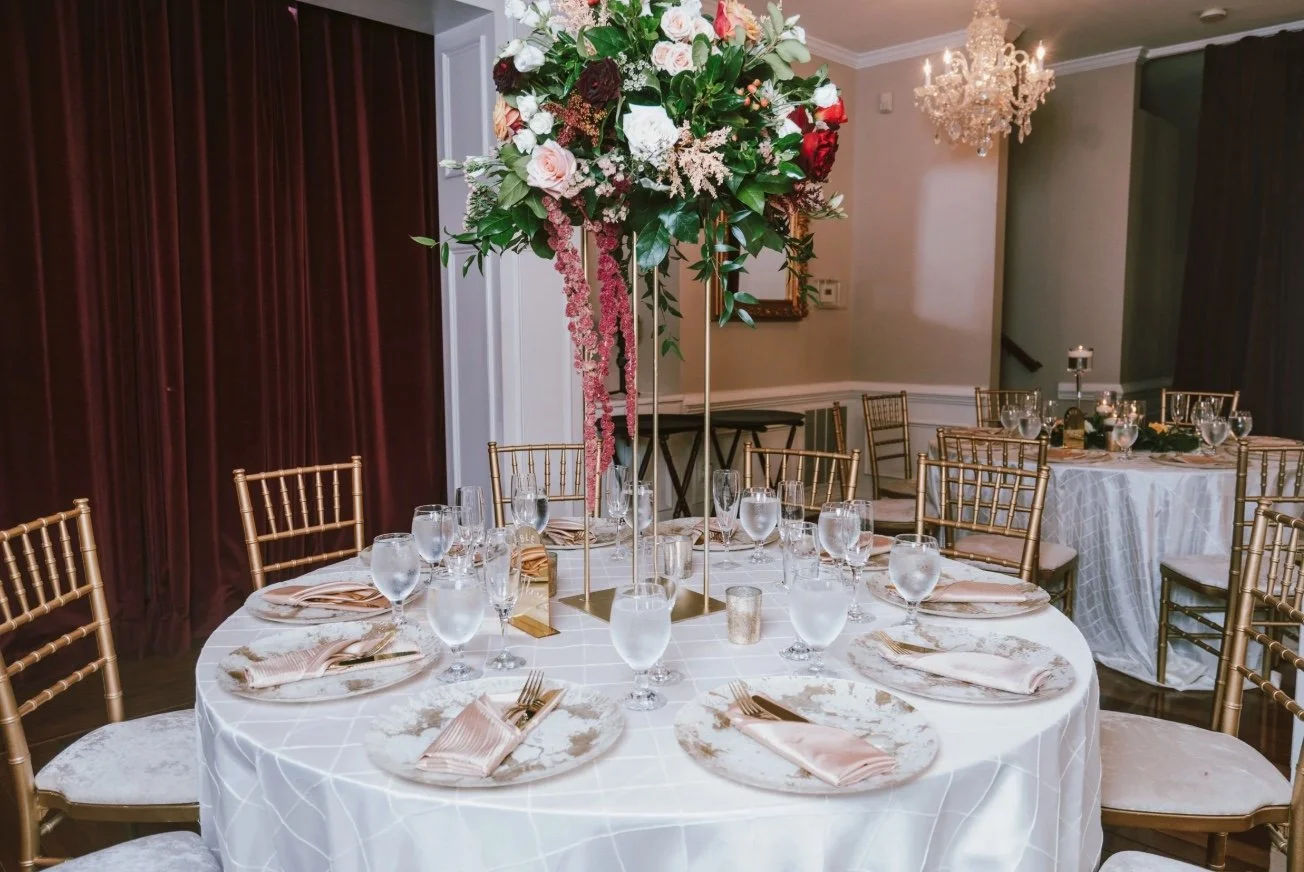
A table is often planned as a checklist: linen, charger, centerpiece, place card. Event tablescape design treats it as something closer to a room in miniature, with its own proportion, layering, and sightlines to consider.
The Table Has Its Own Scale
Every table sits within a larger room, but it also functions as its own contained space. A centerpiece scaled for a grand ballroom can overwhelm a table meant for eight. A minimal arrangement that reads as refined in an intimate space can look sparse on a long banquet table.
Event tablescape design starts with the table's dimensions and guest count, not with a single centerpiece style applied uniformly across every table in the room.
Height Determines Whether Guests Can Talk
The single most common table design mistake is height. A centerpiece placed at eye level blocks conversation across the table for the entire event. Either the arrangement needs to sit low enough to see over, or tall enough that guests are looking beneath it entirely.
Event tablescape design treats this as a functional requirement first and a visual one second. A stunning arrangement that guests have to lean around all evening isn't a successful design decision, regardless of how it photographs.
Layering Height Across the Table
The most considered tables build in more than one height level: a low, textural base layer, a taller accent like candles or bud vases, and a focal element that draws the eye without blocking it. This layering creates depth on a surface that's otherwise flat.
We think about this the same way we think about a room's lighting layers: a single height, however beautiful, tends to read as flat compared to a table with two or three coordinated levels working together.
Material Consistency Across the Table
Linen, glassware, flatware, and florals all carry their own material language. A matte linen paired with high-shine flatware and a glossy charger can feel disjointed if the rest of the palette doesn't tie them together. Event tablescape design treats material choice as a full set of decisions, not a series of separate rentals selected independently.
Consistency doesn't mean uniformity. Mixing a matte linen with a textured charger and soft candlelight can feel more layered than an all-glossy or all-matte table, as long as the choices share a common tone.
Designing for Long Tables Versus Rounds
A long banquet table calls for a different design approach than a round table seating eight or ten. Long tables often support a running, low centerpiece with height variation along its length. Round tables typically need a single, more contained focal point that works from every seat around it.
Event tablescape design adjusts for this shape difference early, since a design built for one table type rarely translates cleanly to the other without real adjustment.
Candlelight as a Design Layer
Candlelight changes how every other element on the table reads once the room dims for evening. Glassware catches and scatters the light. Metallic flatware picks up a warm glow it won't show under daytime lighting. Event tablescape design accounts for this shift, choosing materials that hold up under candlelight and not only under the bright light of a daytime walkthrough.
Place Settings as Detail Work
Beyond the centerpiece, the place setting itself carries design weight: how a napkin is folded, whether a menu card sits atop the charger or beside it, how flatware is spaced. These details are small individually, but consistency across every seat at every table is what makes a room read as fully considered rather than assembled piece by piece.
Tying the Table to the Room
A table's design should echo the palette, lighting, and material decisions already made for the room, whether that's a historic estate in Virginia, a modern hotel ballroom in D.C., or a tented reception in Maryland. Event tablescape design works best as an extension of the room's overall composition, not as an isolated detail decided separately from everything else in the space.
A table carries as much design weight as any larger installation in the room, simply at a closer distance. Built with the same intention as the rest of the space, it becomes part of a cohesive environment rather than a separate detail.
Schedule a consultation to design a tablescape that fits your room and your guest count.