Florals as Architecture, Not Decoration
Florals are often treated as the finishing layer, added once the room is otherwise complete. We treat them as structure.
Floral installation design, approached this way, does more than fill a table or frame a doorway. It can define a room's scale, guide sightlines, and work alongside draping and lighting to shape the entire environment, not just decorate it.
Florals Define Vertical Space
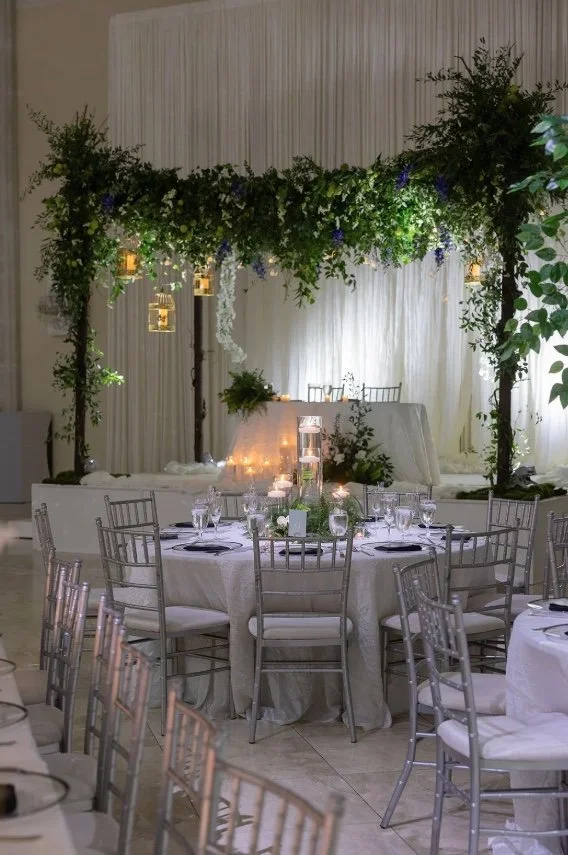
Every room has a fixed ceiling height, but florals can change how that height feels. A suspended installation draws the eye upward and can make a room feel taller than it is. A low, dense centerpiece grounds a space that already feels expansive.
Floral installation design starts with what the room's proportions call for, not with a list of preferred flowers. The structure comes first. The species and color decisions follow.
Structure Before Species
Before we select flower types, we determine the physical form: an arch, a suspended cluster, a floor-to-ceiling wall, an asymmetrical cascade along a staircase. This structural decision is what shapes how the room reads from across the space.
Color and variety matter, but they're secondary to form. A well-built structure in a single flower type often reads as more intentional than a highly varied arrangement without a clear shape behind it.
Florals as a Sightline Tool
Like lighting and furniture, florals can direct where a guest looks. A tall installation at the entrance signals arrival. A lower centerpiece at a dinner table keeps sightlines open across the table for conversation. A dramatic install behind a head table or stage pulls focus toward the evening's key moment.
Floral installation design considers these sightlines from the start, rather than placing arrangements purely by what looks appealing on their own.
Working With Existing Architecture
Many venues, particularly the historic estates found throughout Maryland, Virginia, and Washington, D.C., already have strong architectural features: columns, archways, fireplaces, exposed beams. Floral installation design can soften these features or frame them, but it works best when it responds to what's already there rather than competing with it.
A heavy install placed against an already ornate architectural detail can feel like visual noise. The same install, scaled and positioned to complement that detail, can make the whole room feel more resolved.
Florals and Fabric Together
Some of the most refined installations we build combine florals with draping directly: a floral accent woven into a fabric canopy, an install suspended over a draped backdrop, greenery integrated along a drape's edge rather than sitting apart from it.
This layering is where floral installation design and draping stop functioning as separate line items and start reading as a single, considered environment.
Scale and Proportion at the Table
Table-level florals follow the same logic as large-scale installations, just at a smaller size. A centerpiece that's too tall blocks conversation across the table. One that's too small can feel like an afterthought next to a room with a strong overall design.
Floral installation design accounts for table shape, seating arrangement, and the height of surrounding elements like candles or place settings, so every layer of the tablescape works together rather than in isolation.
Longevity and Practical Considerations
Large installations need to hold their shape through an entire event, often in venues without full climate control. Structural mechanics, water sources, and the right flower selection for the season all factor into whether an ambitious design will actually hold up from cocktail hour through the last dance.
This practical layer is part of what separates a floral installation design that photographs well in a rendering from one that performs reliably in a live event across a full evening. Seasonal availability also plays a role, since certain blooms hold their shape and color better in the heat of a summer tent than others.
Treating florals as structure, rather than as a finishing touch, changes how a room is built from the very first planning conversation. It's a shift in sequence, and it shows in the final result.
Schedule a consultation to talk through floral structure and design for your venue.