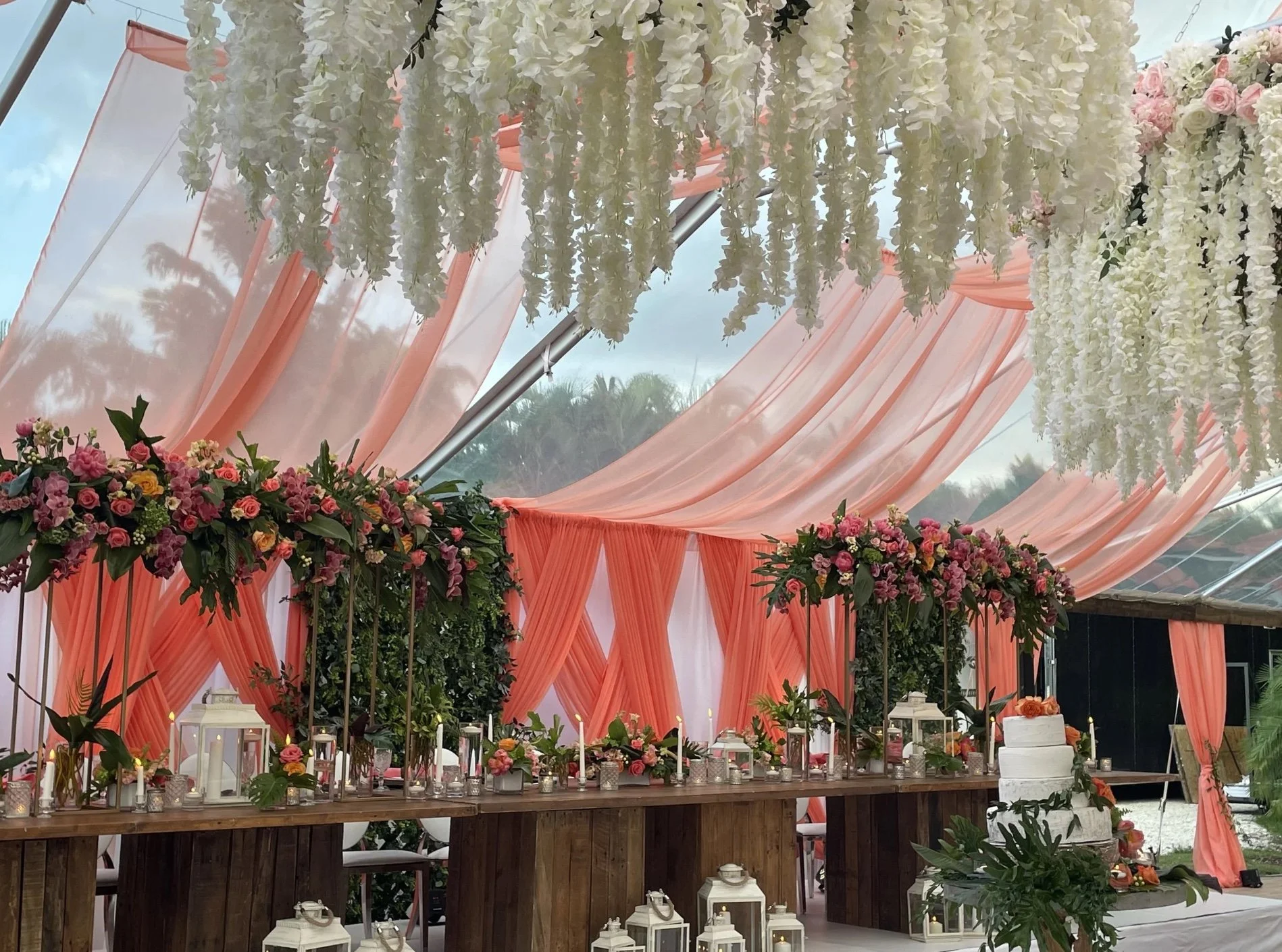
Guests form an impression of an event before they reach the first table. The entrance does that work. Across Maryland, Virginia, and Washington, D.C., we see event entrance design treated as an afterthought, when it is often the decision that separates a considered event from an assembled one.
A luxe look does not begin with the largest installation. It begins with how a guest moves from the street to the room, and what they see along the way.
Start with the sightline
Before choosing a single material, we walk the approach. We look at what a guest sees from the door, from check-in, and from the first turn into the main space. Most venues have at least one view that works against the design: an exit sign, a service door, a bare concrete wall.
Good event entrance design decides what belongs in that first view and resolves what does not. Draping can soften a utilitarian corridor. One anchored element, placed on axis with the door, gives the eye somewhere to land. We recommend a single clear focal point at the entrance rather than several competing ones.
Scale the threshold to the building
A threshold that is too small for the architecture reads as an afterthought. One that is too large overwhelms the guests it is meant to welcome. We measure ceiling height, door width, and corridor depth first, then size the design to match.
In a hotel foyer with a low ceiling, we keep elements horizontal and layered so the space feels wider rather than compressed. In a historic estate with tall doorways, common across Northern Virginia and the Maryland countryside, vertical drapery and taller florals suit the proportion.
Use materials to preview the room
The entrance should introduce the room without repeating it. Fabric, finish, and color establish the palette, and they should feel related to the main space, not identical to it.
Heavier draped panels create a sense of enclosure and arrival. Lighter sheers suit a bright, open foyer. Furniture adds another layer. A console, a pair of upholstered benches, or a sculptural sign table gives the area structure and gives guests a natural place to pause. Each piece is chosen for its scale and finish in relation to the whole.
Light the arrival deliberately
Lighting temperature changes how every material reads. Cool overhead light flattens fabric and makes florals look sharp. Warmer, lower light adds depth and signals that the space has been considered.
Where a venue limits what we can change, we use uplighting and focused accents to shape the entry without altering the building’s fixtures. The result is a controlled, consistent first impression, even in a space we do not own.
Work within the venue, not against it
Most venues set rules for load-in times, attachment points, and open flame. We review these early so the entrance design is achievable as drawn, not simplified at the last minute.
A considered entrance often relies on what is already there. A staircase, a set of double doors, or a high window can carry more of the design than any addition. Our role is to frame what the building does well and quietly resolve what it does not.
Plan the flow before the look
An entrance has a job beyond appearance. Guests arrive in clusters, stop to greet one another, and check in. If the design blocks that movement, the room feels crowded before the event has started.
We map guest flow first, then place installations around it, leaving clear paths for coats, signage, and staff. A design that looks composed but slows arrival has not solved the problem.
What a luxe entrance has in common
Across the events we design, the strongest entrances share a few qualities. They have one focal point. They are sized to the architecture. They use a limited set of materials. They leave room to move. Nothing is added for its own sake.
When the entrance is designed this way, the rest of the event inherits that clarity. Guests do not need to be told the evening has been planned with care. They can see it from the first step inside.
Planning an event in Maryland, Virginia, or Washington, D.C.? Begin the design process with Tre Belle Events.